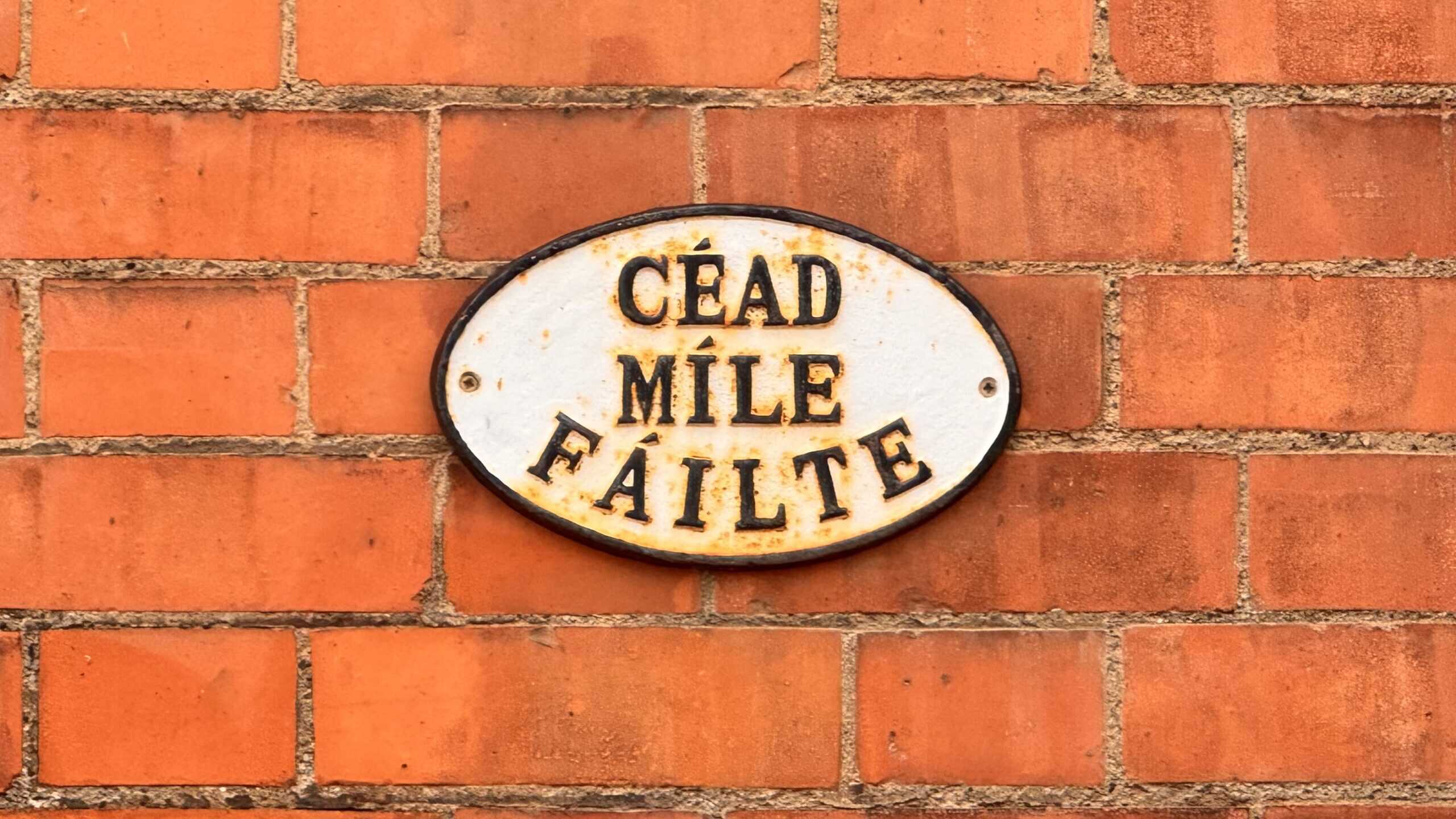
If you’ve spent even a day travelling in Ireland, you’ve already met the Irish language, on road signs, in place names, in pub session tunes, and in the warm, familiar phrase “céad míle fáilte” (a hundred thousand welcomes). Irish (or Gaeilge) isn’t just a “nice-to-have” cultural addition. It’s a living thread that runs through Ireland’s history, identity, humour, music, and landscape. This guide explores the history of the Irish language, why it declined and how it’s thriving again, and the most useful Irish phrases for travellers.
What is the Irish language?
Irish (Gaeilge) is a Celtic language, part of the Goidelic (Gaelic) branch that also includes Scottish Gaelic and Manx. Irish is one of Europe’s oldest living literary languages, with early records stretching back to inscriptions and medieval manuscripts.
A history of Gaeilge
Before books: Ogham and the earliest written Irish
One of the most fascinating doorways into early Irish is Ogham, an alphabet made of strokes carved along the edge of stone. Ogham inscriptions are generally dated to around the 4th–6th centuries, and many record names and kinship lines (the ancient version of “this is who’s buried here” or “this is who owned this land”).
You can still see Ogham stones today, especially in the south-west, often in small local heritage sites that feel wonderfully “off the beaten path.”
Monasteries, manuscripts, and the medieval flowering

With the spread of Christianity, Ireland’s monastic culture became a powerhouse of learning. Irish scribes didn’t just copy texts, they developed distinctive art and scholarship that shaped medieval Europe. Irish language material appears in early manuscripts and glosses (notes written in margins), while Irish literature flourished in the early medieval period.
When people think of Ireland’s manuscript heritage, the Book of Kells often steals the spotlight. While it’s a Latin Gospel manuscript, it sits within the same world of Irish monastic culture that preserved and transformed learning across the island.
Language under pressure: colonisation and cultural shift
Over centuries, Irish remained the everyday language for the majority of people across Ireland. But political and economic power increasingly centred on English, especially from the Tudor period onward, and the social prestige of English grew. The long story here is complex, but the result was clear: Irish became associated with rural life and marginalisation, while English became linked with opportunity and administration.
The Great Famine and a dramatic decline
The 19th century brought the most devastating blow. The Great Famine (1845–1852) caused enormous loss of life and mass emigration, particularly in areas where Irish was strongest. That demographic collapse accelerated the shift from Irish to English.
Revival and renewal: the Gaelic League and the 20th century
The late 19th and early 20th centuries saw a cultural reawakening: Irish scholars, writers, and activists pushed to revive the language through education, publishing, and community life. The language became a key symbol of identity and self-determination.
After independence, Irish was given a central constitutional position: Article 8 of Ireland’s Constitution states that Irish is the first official language, with English recognised as a second official language.
Irish today: where you’ll hear it
The Gaeltacht: Ireland’s Irish-speaking heartlands
The Gaeltacht refers to regions where Irish is (or was until recently) the primary community language. Official Gaeltacht areas cover parts of Donegal, Mayo, Galway, Kerry, plus sections of Cork, Waterford, and Meath and some inhabited islands too.
If you travel through Gaeltacht areas, you’ll notice:
- road signs that may appear in Irish only
- a higher chance of hearing Irish spoken in shops, schools, pubs, and homes
- local cultural events (music, storytelling, sean-nós singing) where Irish feels natural—not performative
The main Gaeltacht regions
- Donegal (Dún na nGall): Famous for rugged Atlantic scenery and Ulster Irish, with strong language communities in areas like Gaoth Dobhair (Gweedore) and surrounding districts.
- Mayo (Maigh Eo): A quieter, spacious Gaeltacht, often grouped into Tourmakeady (Tuar Mhic Éadaigh), Achill (Acaill), and Erris (Iorras), great for pairing culture with dramatic coastline.
- Galway (Gaillimh): One of the largest Gaeltacht areas, closely linked with Connemara and deeply rooted Irish-language culture.
- Kerry (Ciarraí): Two key regions Corca Dhuibhne (Dingle Peninsula) and Uíbh Ráthach (part of Iveragh/Ring of Kerry), where Gaeilge, heritage, and music fit naturally into touring routes.
- Cork (Corcaigh): Includes Gaeltacht Mhúscraí (Muskerry) plus the Irish-speaking island Oileán Chléire (Cape Clear).
- Waterford (Port Láirge): A compact coastal Gaeltacht near Dungarvan, centred on An Rinn (Ring) and An Sean Phobal (Old Parish).
- Meath (An Mhí): A unique eastern Gaeltacht focused around Ráth Chairn and Baile Ghib, showing Irish isn’t only a “far west” story.
How many people speak Irish?
Ireland’s census data is especially useful here because it separates ability from daily use. According to Ireland’s CSO, of those who said they could speak Irish, 623,961 spoke it daily (within or outside the education system), and 71,968 spoke it daily outside the education system.
That’s a big story in one statistic: Irish is widely learned, but daily community use is concentrated and that’s exactly why Gaeltacht protection and Irish-medium initiatives matter.
Irish in media: radio and TV that made a difference
Modern broadcasting has been huge for visibility and everyday usage. Raidió na Gaeltachta began broadcasting in 1972, creating a national platform rooted in Gaeltacht communities.
And Irish-language television arrived when Teilifís na Gaeilge (TnaG) launched on 31 October 1996 (later becoming TG4).
Even if you don’t speak Irish, hearing it spoken casually about sport, weather, music, news, changes how you perceive it: not as a museum piece, but as a normal, modern language.
Irish is everywhere: place names you’re already using
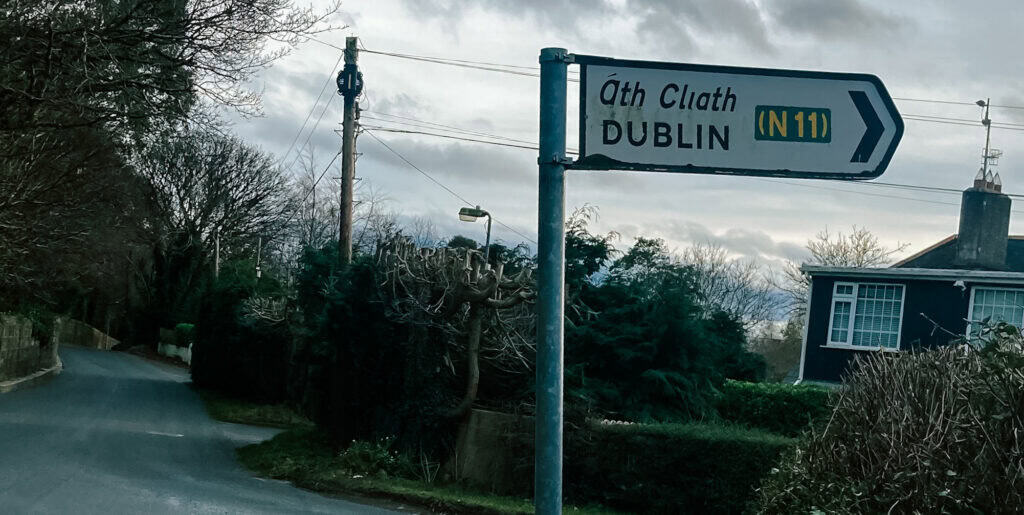
One of the easiest ways to “feel” Gaeilge is through Irish place names. Many Irish names describe landscape features, so learning a few building blocks turns your itinerary into a storybook.
A few examples:
- Dún = fort (e.g., Donegal / Dún na nGall)
- Cill = church (often linked to a saint; e.g., Kildare / Cill Dara)
- Béal = mouth (of a river)
- Inis = island (e.g., Inis Mór on the Aran Islands)
- Gleann = valley (think Glendalough / Gleann Dá Loch)
Once you start spotting these, Ireland feels more readable, like you’ve gained a “local lens” for the landscape.
Interesting facts about Irish Language
Irish has a different “default” word order: English usually goes Subject–Verb–Object (“I see the castle”). Irish commonly uses Verb–Subject–Object (“See I the castle”). It’s one reason Irish can feel like it’s dancing to a different rhythm.
Irish uses “mutations” at the start of words: Instead of changing word endings all the time, Irish often changes the beginning of words depending on grammar (you’ll see this on signs and menus). It looks strange at first, but it’s a normal feature of Celtic languages.
Ogham is basically ancient Irish “edge writing”: Ogham letters are carved along a line, often the edge of a standing stone. It’s minimalist and brilliant, and you’ll recognise it instantly once you’ve seen a photo.
Irish is officially central to the Irish state: That constitutional statement matters: Irish isn’t “just heritage”, it has formal recognition as the first official language.
There’s a huge Irish-language cultural festival tradition: Oireachtas na Gaeilge is an annual festival tradition with roots going back to the late 19th century, celebrating Irish-language arts and culture.
Cúpla focal: useful Irish phrases for your Ireland trip
You don’t need perfect grammar to make a good impression. A few phrases go a long way—especially in smaller towns and Gaeltacht areas.
Hello / Hi: Dia dhuit (DEE-ah gwit) = “God be with you” (traditional hello)
Reply: Dia is Muire dhuit (DEE-ah iss MWIR-ah gwit) — “God and Mary be with you”
Thank you: Go raibh maith agat (guh rev mah a-gut)
Please: Le do thoil (leh duh hull)
Goodbye: Slán (slawn)
Cheers / Health: Sláinte (slawn-cha)
A classic proverb: Níl aon tinteán mar do thinteán féin — “There’s no place like home.”
Tip for pronunciation: don’t worry about sounding “perfect.” Irish speakers are usually delighted by genuine effort, especially when it’s paired with curiosity and respect.
Where to experience Irish on your travels

If you want your trip to include real contact with Irish culture and language, these experiences are especially rewarding:
- Drive through (or stay in) a Gaeltacht area
You’ll hear Irish naturally, see Irish-first signage, and often find local crafts and cultural centres that don’t feel touristy. - Visit an island community
Several inhabited islands are in the Gaeltacht. Island life tends to preserve language, music, and storytelling traditions in a very tangible way. - Seek out live traditional music and sean-nós
Even outside the Gaeltacht, traditional sessions often include Irish-language songs. If you want, a driver-guide can recommend the right venues for your route and preferences. - Add a “language lens” to iconic sites
Even at famous landmarks: monastic sites, medieval towns, coastal villages, place names and local terms add meaning to what you’re seeing. That’s one of the joys of a private tour: you can pause for context, not just photos.
 Get in touch to book you Irish Adventure
Gaeilge isn’t just history, it’s a welcome
The Irish language carries Ireland’s worldview: place-based, poetic, funny, stubborn, tender, and full of story. Even learning a cúpla focal turns a trip into something more connected, because you’re not only visiting Ireland, you’re beginning to read it.
If you’d like, Gateway to Ireland Tours can help you shape an itinerary that includes Gaeltacht moments, local heritage stops (like Ogham stones and monastic sites), and cultural experiences where Irish is part of the air, not a performance.
Slán agus beannacht, goodbye and blessings.
Leave a Reply