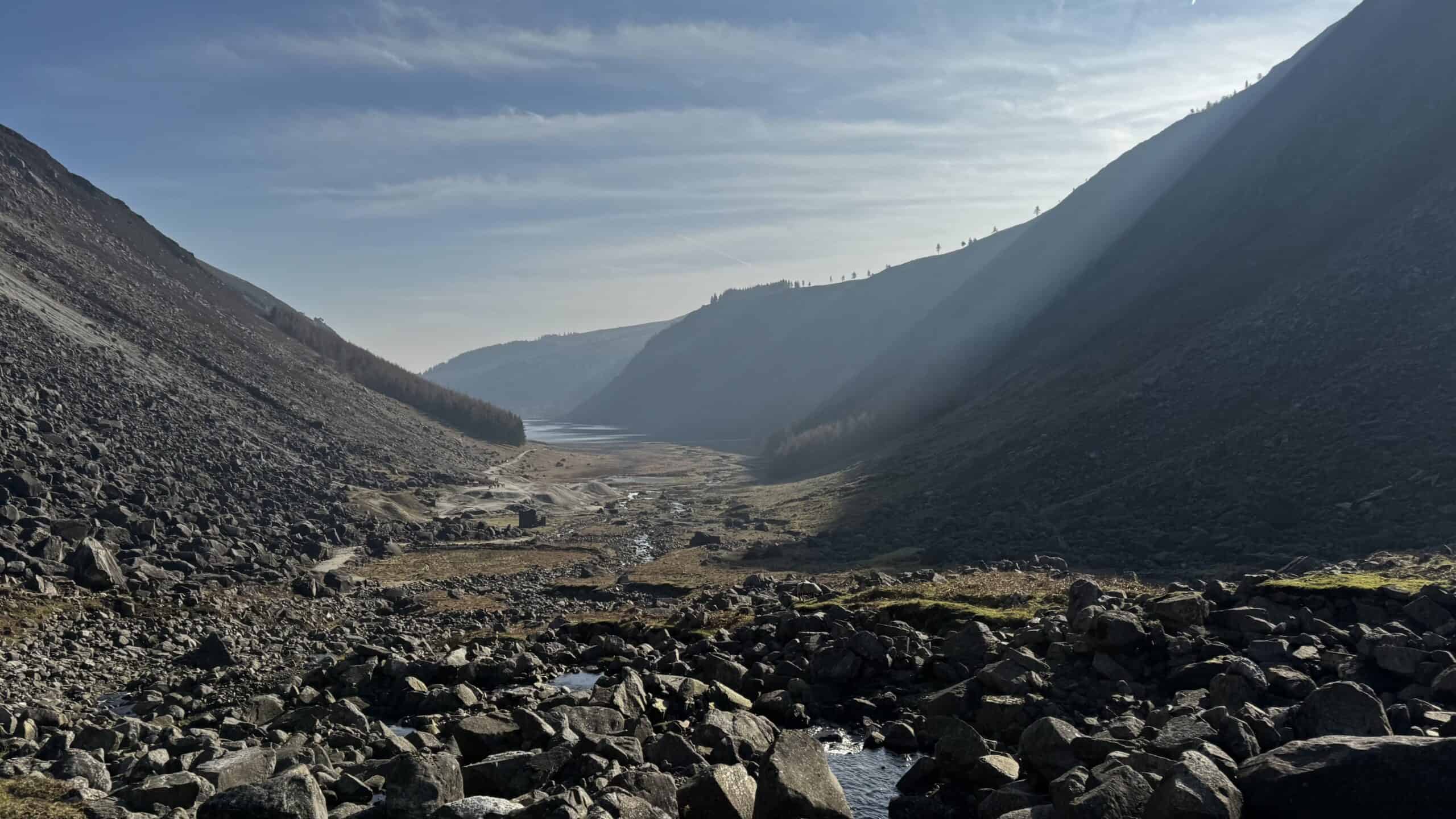
There are days in Ireland that don’t just show you the country, they get under your skin. Our day trip to the Wicklow Mountains was one of those. Just forty minutes south of Dublin, the city noise faded, the horizon opened up, and a different Ireland took over: one of heather-covered hills, cloud-shadowed valleys, mirror-still lakes, and stone walls that have been standing since monks first chose this hidden glen.
We visited Glendalough and Guinness Lake in a single day, and came back with far more than photographs. We came back with a real sense of why the people of Dublin have always called Wicklow their escape: their wild, beautiful, centuries-deep backyard.
If you are planning a day trip from Dublin and wondering whether Wicklow deserves a full day, let me answer that clearly: it deserves more. But one well-planned day will leave you changed.
Why the Wicklow Mountains?
Wicklow is known as the Garden of Ireland, and the name earns its keep the moment you leave the motorway and begin climbing into the hills.
The landscape shifts dramatically: broad glacial valleys carved during the last Ice Age, rivers brown with peat, ancient oak woods clinging to hillsides, and a quality of light that photographers and painters have been chasing for centuries.
The Wicklow Mountains National Park covers over 20,000 hectares and is the largest national park in Ireland.
It protects habitats ranging from blanket bog to upland heath, and it shelters some of the most historically significant early Christian sites in the entire country.
What makes Wicklow ideal for a day trip is that the distances are short but the contrasts are enormous. Ancient ruins and wild swimming lakes sit side by side. You can stand in a sixth-century monastic city in the morning and watch a waterfall tumble into a remote reservoir in the afternoon, all without once feeling rushed.
Glendalough: Where History and Landscape Become One
The Valley of the Two Lakes
The name Glendalough comes from the Irish Gleann Dá Loch, meaning “Glen of the Two Lakes.” It is one of those place names that tells you everything you need to know: this is a valley defined by its water, by the way two dark glacial lakes sit cupped in the hills like something nature placed there deliberately.
We arrived in the morning, when the mist was still on the upper lake and the round tower was catching the first light. It is one of those moments that makes you stop completely, not to take a photograph, but just to look.
St Kevin and the Founding of a Monastic City
The history of Glendalough begins in the sixth century with a man who chose this remote valley precisely because it was remote. St Kevin (Caoimhín in Irish), meaning “of gentle birth”, was a monk, hermit, and scholar who retreated to Glendalough around 498 AD seeking solitude and closeness to God. What he built instead was one of Ireland’s most important Early Christian monasteries.
The most famous tale describes Kevin kneeling in prayer with his arms outstretched when a blackbird landed in his open palm and began to build a nest. Rather than disturb the bird, Kevin remained motionless until the eggs hatched and the chicks flew. In another legend, a local woman fell in love with Kevin and pursued him; he retreated deeper into the wilderness, and a lake in the valley is said to mark the spot where her pursuit ended. These stories are old, layered, and not always comfortable, but they are part of Glendalough’s texture.
The Monastic Site: What You Will See
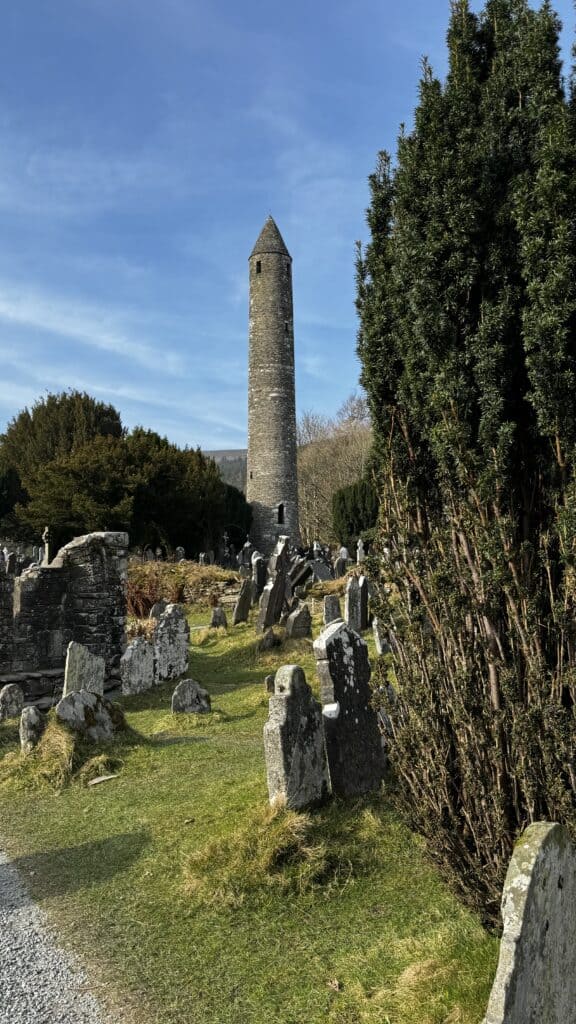
The main monastic enclosure at Glendalough is remarkably well preserved and utterly atmospheric.
The most iconic landmark is the Round Tower, standing at approximately 30 metres tall, with its distinctive conical cap restored in the nineteenth century.
Round towers were built throughout Ireland from roughly the ninth to the twelfth centuries, serving as bell towers, landmarks for pilgrims, and, most famously, as refuges during Viking raids. Glendalough’s tower is one of the finest surviving examples in the country.
The Cathedral of St Peter and St Paul is the largest building on the site, dating from the ninth to twelfth centuries, with a beautiful Romanesque chancel arch that frames a view of the hillside beyond.
Walking through the monastic enclosure, past the old gateway, through the graveyard where crosses lean at thoughtful angles, and out to the lower lake beyond, is one of those experiences that works its quiet effect gradually. You don’t leave feeling you’ve “done” a heritage site. You leave feeling you’ve been somewhere.
The upper lake trail takes you further into the valley, past the dramatic Poulanass Waterfall and along the lakeside where the landscape closes in and the hills rise steeply on either side. This is where Glendalough reveals its other character: not the preserved historical monument, but the wild, primeval valley that Kevin chose for its beauty and its silence.
Guinness Lake: Drama, Legend, and the Quiet of the Mountains
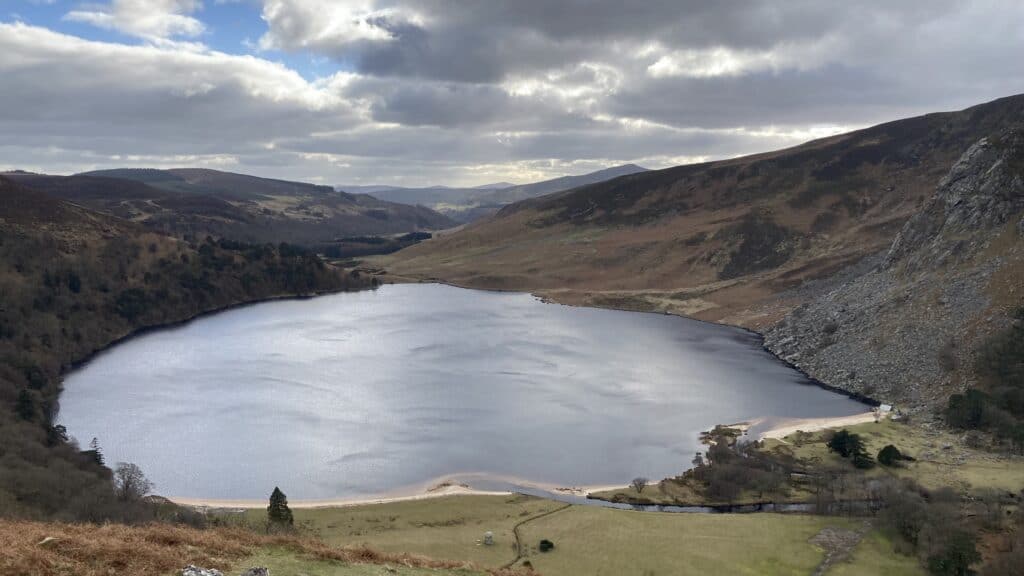
Finding the Upper Reservoir
After Glendalough, the day opened up differently. The drive into the hills above the valley took us up through the one of the most dramatic drives in Ireland and eventually to Lough Tay, known locally as Guinness Lake.
The lake sits at the bottom of a steep-sided glacial corrie, with the Luggala mountain rising sharply behind it and pale golden sand at the water’s edge. The combination of the dark, almost black water, the white sand beach, and the sheer walls of the surrounding hills creates something that looks almost theatrical — too dramatic to be entirely real.
Why Is It Called Guinness Lake?
The Guinness family (yes, the brewing dynasty) have been associated with the Luggala Estate, which occupies the eastern shore of Lough Tay, since the 1930s. The estate and its distinctive white lodge were a beloved retreat for Garech de Brún (born Garech Browne), a member of the Guinness family and one of the great patrons of traditional Irish music, who was instrumental in founding Claddagh Records and preserving the Irish musical tradition. The estate was a gathering place for poets, writers, musicians, and artists for decades.
The name Guinness Lake is entirely unofficial and entirely beloved, one of those pieces of living local geography that maps don’t record but everyone uses.
The View from Above
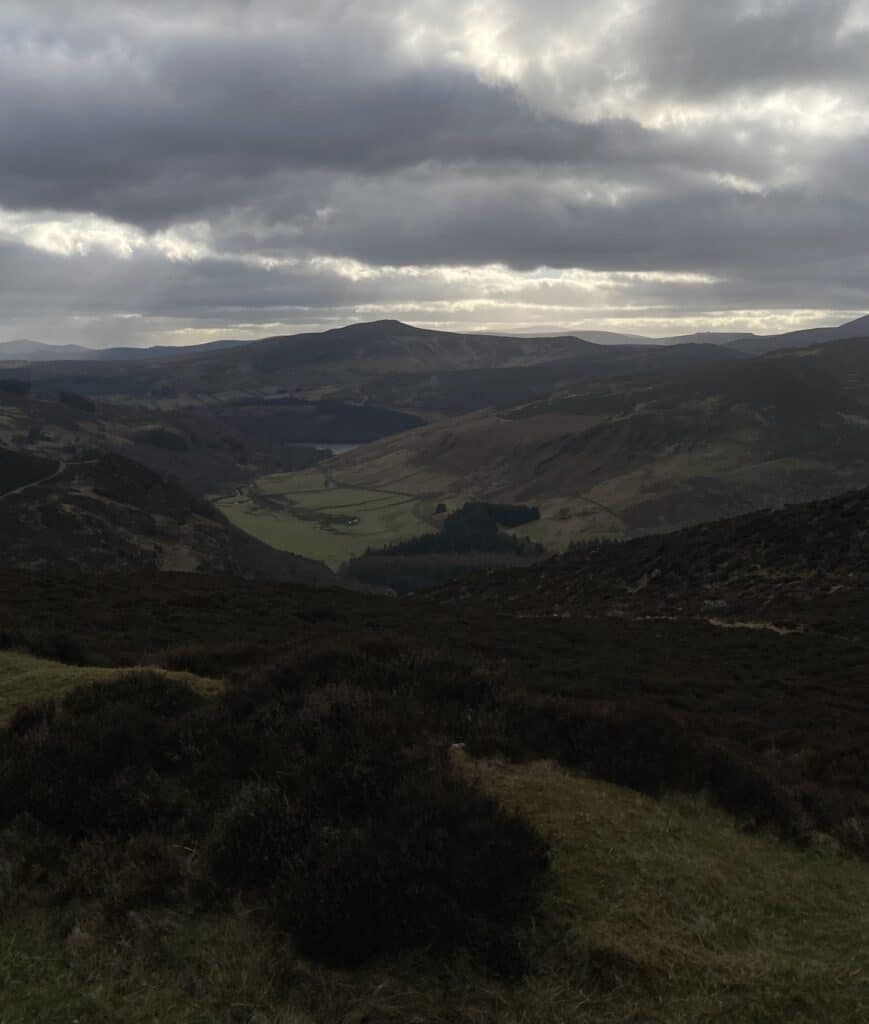
Lough Tay is best appreciated from the viewpoint on the road above, a short walk from the car park brings you to the edge of the escarpment, and the view that opens below you is one of the most photographed in Wicklow.
The dark water, the pale sand, the green and brown hills, the toy-small lodge on the far shore: it is a composition that looks like a painting.
On a clear day, the scale is almost disorientating. On a misty day, when the clouds come low and the far shore vanishes, it is something else entirely.
History, Folklore, and the Layers Beneath
The Tuath and the Fairy Forts
Wicklow, like all of Ireland, is littered with the remains of ancient ringforts (circular earthwork enclosures) that served as the homes and farmsteads of early medieval Irish families. In the Irish tradition, these are often called fairy forts or lios, and they carry a powerful superstition: to damage or disturb one brings bad luck, illness, or worse.
This is not merely ancient folklore. Ask any farmer in Wicklow about the fairy forts on their land and the answer will usually be some version of “I wouldn’t touch it.” The tradition of the sídhe, the supernatural beings of Irish mythology, sometimes translated as fairies but far older and stranger than the Victorian idea of the word, is deeply embedded in the Wicklow landscape. The green mounds in the fields are left alone, the old thorn trees that mark their boundaries are not cut, and the old stories are kept alive in a way that doesn’t require belief to carry weight.
Brigid’s Cross and the Mountain Traditions
The county of Wicklow sits within the ancient province of Leinster, and its traditions are rooted in the Celtic calendar. St Brigid’s Day (1st February), the start of spring in the Celtic year, is still marked in Wicklow communities with the making of the traditional Brigid’s Cross from rushes, a custom that predates Christianity and connects to the goddess Brigid of Irish mythology. The cross is hung in homes and over doors for protection through the year.
Planning Your Day Trip to Wicklow: Practical Tips
A day in the Wicklow Mountains works best when it isn’t over-scheduled. The landscape rewards slowness, and the best moments: the light on the upper lake, the silence inside the monastic enclosure, the view down to Lough Tay, come to those who are not watching the clock.
What to wear: The Wicklow Mountains are serious walking country. Comfortable waterproof footwear is essential, the upper lake trail involves uneven ground and a light waterproof layer is always worth carrying, whatever the forecast says. Ireland’s weather is famously provisional.
FAQs
How far is Glendalough from Dublin?
Glendalough is approximately 50 kilometres south of Dublin city centre, making it around a 1-hour drive depending on traffic and your route. It is one of the most popular day trips from Dublin for exactly this reason: it is genuinely close, yet feels completely removed from city life. Private tours from Dublin can collect you directly from your hotel and have you in the Wicklow Mountains within the hour.
What is the best way to visit both Glendalough and Guinness Lake in one day?
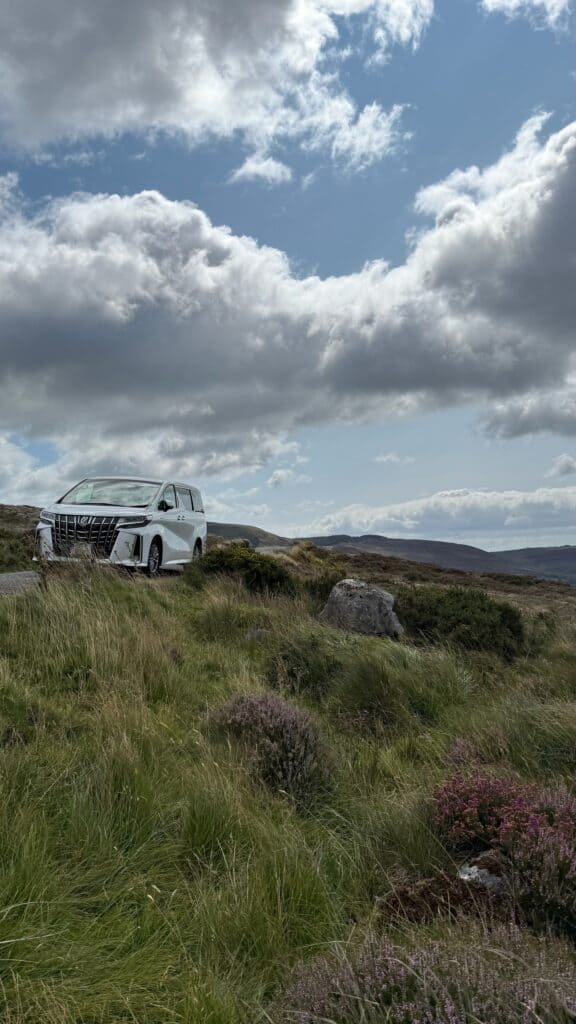
The most efficient and enjoyable way is by private guided tour. Lough Tay (Guinness Lake) is not served by public transport and requires driving through the mountains, a route that is both scenic and best navigated with local knowledge. A private guided day tour from Dublin can combine both sites comfortably, with time to walk the Glendalough valley trail, enjoy the views at Lough Tay, and take in other highlights such as the Sally Gap moorland or the Wicklow Way, all without rushing.
Is Glendalough worth visiting?
Unequivocally yes. Glendalough is one of the finest early Christian monastic sites in Europe, combining remarkable architectural heritage with a dramatic natural setting in the glacial valley of the Wicklow Mountains. The round tower, the cathedral ruins, the lakeside trails, and the atmosphere of the valley make it one of those rare places that exceeds expectations. It is suitable for all ages and levels of fitness, with the option to extend the experience with walks into the surrounding hills for those who want more.

Leave a Reply