
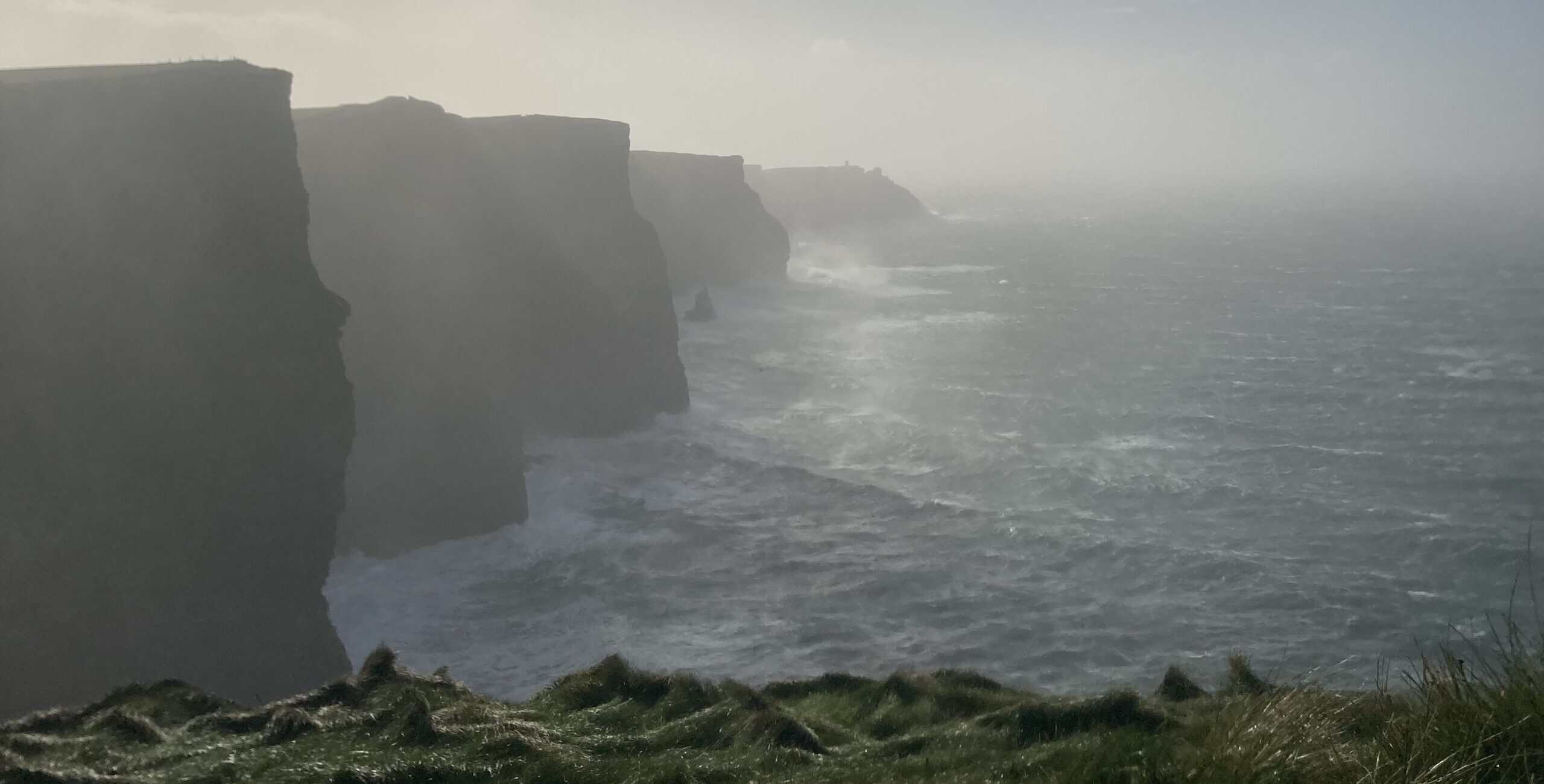
Imagine standing on the windswept cliffs of the Wild Atlantic Way as gale-force winds whip the ocean into a frenzy of white-capped waves. Salt spray stings your face, ancient stone walls groan under the pressure, and the sky turns a dramatic shade of steel grey. This isn’t a scene from a movie – it’s everyday Ireland in the grip of a powerful storm. The magic of Storms in Ireland is palpable in these moments.
There is a specific kind of magic that settles over the Emerald Isle when the sky turns the color of pewter and the Atlantic Ocean begins to roar. To truly know Ireland, one must understand its weather. While our lush green landscapes are the product of soft Irish rain, our rugged cliffs and resilient spirit are forged by the legendary storms in Ireland that sweep in from the west. These storms in Ireland have shaped the land and the people for generations, defining our unique identity.
Storms in Ireland are more than just weather; they’re woven into the island’s history, folklore, and very identity. From devastating historical events that reshaped communities to the modern system of giving storms names like Bram or Éowyn, these tempests define the rugged beauty that draws travellers from around the world and highlight the significance of Storms in Ireland in shaping our culture.
We believe that every season offers a unique perspective on our beautiful island. While summer brings long golden twilights, the “Storm Season” (typically October through March) reveals the raw, cinematic power of nature. In this deep dive, we explore the history, the science, and the fascinating culture behind the storms in Ireland.
The Power of the Atlantic: Why Does Ireland Get So Much Wind?
To understand Irish storms, we have to look at our geography. Ireland sits at the very edge of Europe, acting as the continent’s first line of defense against the vast Atlantic Ocean.

Most of our weather systems are driven by the North Atlantic Drift and the Jet Stream, a high-altitude ribbon of fast-moving air that acts like a conveyor belt for low-pressure systems. When cold air from the Arctic meets warm air from the tropics over the Atlantic, it creates “weather bombs” or depressions. Because there is no landmass between Newfoundland and Galway to slow these winds down, they arrive on our shores with incredible momentum.
This constant battering has shaped the Wild Atlantic Way.
From the sheer face of the Cliffs of Moher to the jagged peaks of Skellig Michael, the landscape is a testament to the transformative power of wind and water.
A History of Fury: Ireland’s Most Famous Storms

Irish history is punctuated by great gales that have entered into local folklore. These weren’t just weather events; they were “calendar markers” that defined generations.
Oíche na Gaoithe Móire: The Night of the Big Wind (1839)
The most legendary storm in Irish history occurred on January 6, 1839. Known in Irish as Oíche na Gaoithe Móire, it remains the most devastating storm ever recorded here.
On that night, a hurricane-force tempest swept across the country. It is estimated that 25% of all houses in Dublin were damaged, and thousands of thatched cottages across the countryside were simply leveled. The wind was so strong that it blew the water out of canals and caused the River Liffey to rise over its banks.
Hurricane Debbie (1961)
While actual hurricanes are rare in Ireland (we usually get “post-tropical cyclones”), Hurricane Debbie in 1961 was an exception. It maintained much of its hurricane strength as it hit the west coast. With gusts reaching 180 km/h (113 mph), it holds the record for the highest wind speeds ever measured in Ireland at sea level.
Storm Ophelia (2017)
In recent memory, Storm Ophelia stands out. It was the easternmost Atlantic hurricane on record before it transitioned into an extra-tropical storm. The entire country was placed under a “Status Red” weather warning, the first time this had happened for the whole island. The sky turned an eerie shade of orange as the storm pulled Saharan dust and smoke from Iberian wildfires across our heavens.
How Storms in Ireland Are Named?
If you’ve ever followed Irish weather news, you’ve probably heard names like Bram, Éowyn, or Darragh. But how exactly do storms in Ireland get their names? The answer lies in a clever public-awareness initiative launched in 2015.
In Ireland, we don’t just “have weather”; we personify it. There is something uniquely Irish about looking out at a horizontal sheet of rain and saying, “Sure, Storm Isha is having a right go at the bins today, isn’t she?” But the process of naming these tempests is far more than just a bit of local fun, it’s a carefully choreographed dance between three nations.
The “Triple Threat” Alliance
Since 2015, Met Éireann hasn’t acted alone. They joined forces with the UK Met Office and the KNMI (the Dutch national weather service) to form what is known as the “Western Group.” Together, they sit down every summer to decide who will be the “celebrity” villains of the coming winter.
The goal? It’s simple psychology. Humans are much more likely to listen to a safety warning about “Storm Fergus” than they are to “Extra-tropical Depression 14.” By giving the wind a name, we give it a personality and we give people a reason to take it seriously.
The Alphabetical Rulebook
The list resets every September, starting with the letter ‘A’ and working its way through the alphabet. However, you’ll never meet a Storm Quentin, Storm Ulysses, or Storm Zorro.
To stay in sync with the US National Hurricane Center’s naming conventions, the letters Q, U, X, Y, and Z are strictly forbidden. This ensures that if a storm decides to hop across the Atlantic and become a hurricane, there’s no confusion in the international headlines.
A Nod to the Ancestors
What makes the Irish list truly special is how Met Éireann uses it to celebrate Irish heritage. In recent years, the list has been a roll-call of Irish greatness and folklore.
- The Legends: Names like Fionn and Oisín pull straight from the Fenian Cycle of Irish mythology.
- The Scientists: We’ve seen storms named after Irish pioneers, like Storm Jocelyn (for astrophysicist Jocelyn Bell Burnell), proving that even our bad weather can be educational.
- The Classics: Names like Pádraig and Eibhlín ensure that even as the wind howls, it carries the distinct rhythm of the Irish language.
Why Do Some Storms “Steal” Names?
Occasionally, there is a storm with a distinctly “un-Irish” name, like Storm Jorge or Storm Lorenzo. This happens when a storm is “born” elsewhere. If a weather system is first named by the US National Hurricane Center or the French weather service (Météo-France), we keep their name out of respect. It’s the meteorological equivalent of keeping your name when you move to a new country!
Curious Fact: Did you know that the 2024/2025 list was compiled using suggestions from the public? Thousands of people wrote in, hoping to see their own name, or perhaps the name of a particularly “windy” relative, immortalised in a Status Red warning.
Folklore and the Wind: The Banshee’s Cry
In ancient Ireland, the wind wasn’t just air pressure; it was a voice. In Irish mythology, the Banshee (Bean Sí) is a female spirit whose piercing wail heralds a death in certain Irish families. Many folklorists believe the legend of the Banshee’s cry originated from the sound of high-pitched winds whistling through the gaps in stone walls or the eaves of thatched roofs during a winter gale.
Similarly, the Sídhe (fairy folk) were often said to travel within “fairy wind”, sudden gusts of wind on a calm day that would kick up dust and leaves. If you were caught in a storm, it was often said the “host of the air” was passing by.
The Silver Lining: Why Storm Season is Great for Travelers
You might think that a blog post about storms would discourage visitors, but we see things differently. There are several reasons why the “wild” side of Ireland is worth experiencing:
The Drama of the Landscape
The Cliffs of Moher are impressive in the sunshine, but they are sublime when a gale is blowing. Seeing the “sea spray” rise hundreds of feet into the air, sometimes even blowing up the cliff face, is a sight you will never forget.
The “Cozy” Factor
There is no better feeling than being inside a traditional Irish pub with a roaring peat fire while a storm rattles the windows outside. This is the essence of hygge (or as we say in Irish, compord). A pint of Guinness or a hot whiskey tastes significantly better when you’ve just come in from the wild Atlantic wind.
Fewer Crowds
The most famous sites in Ireland are much quieter during the stormier months. You can have the Giant’s Causeway or the Ring of Kerry almost to yourself, allowing for a much more intimate connection with the land.

Photography
For photographers, the light during a storm is unparalleled.
The “clearing shower” light, where the sun breaks through dark, dramatic clouds and creates a high-contrast, vivid landscape that looks incredible on camera.
Safety Tips for Stormy Weather in Ireland
While we love the drama of a storm, safety is our top priority. If you are traveling with us or exploring on your own during a weather warning, keep these tips in mind:
- Respect the Water: “Sneaker waves” are common during storms. Never stand on wet rocks near the shoreline; if the rocks are wet, it means the water has reached them recently.
- Check Met.ie: Met Éireann is the gold standard for Irish weather. Check their “Warnings” page daily.
- Yellow, Orange, Red: Yellow: Be aware. Travel is usually fine, but be cautious. Orange: Be prepared. Coastal areas may be dangerous; some outdoor attractions may close.Red: Take action. Stay indoors. Public transport often stops, and it is not safe to be on the road.
- Driving: Irish roads are narrow and often lined with trees. During high winds, falling branches are a real hazard. Slow down and give yourself plenty of time.

Leave a Reply